
Sun and moon tattoos bring two familiar sky symbols into one design. Some people choose them to represent contrast, balance, or a meaningful relationship; others simply like the shape. There is no single meaning that fits everyone. These 25 sun and moon tattoo ideas range from small ankle and wrist accents to detailed faces, phases, and larger compositions, with practical notes to help you plan a design that feels like yours.
Gallery photos are starting points, not ready-made stencils. Your artist can adjust the scale, spacing, line weight, and direction for your body. Before choosing a reference, decide whether you prefer one fused emblem, two separate symbols, or a scene that includes stars, clouds, or water.
25 Sun and Moon Tattoo Ideas
Use the ideas below to compare composition and placement. We have moved the first gallery design to the end, while keeping the remaining image-and-idea sequence together.
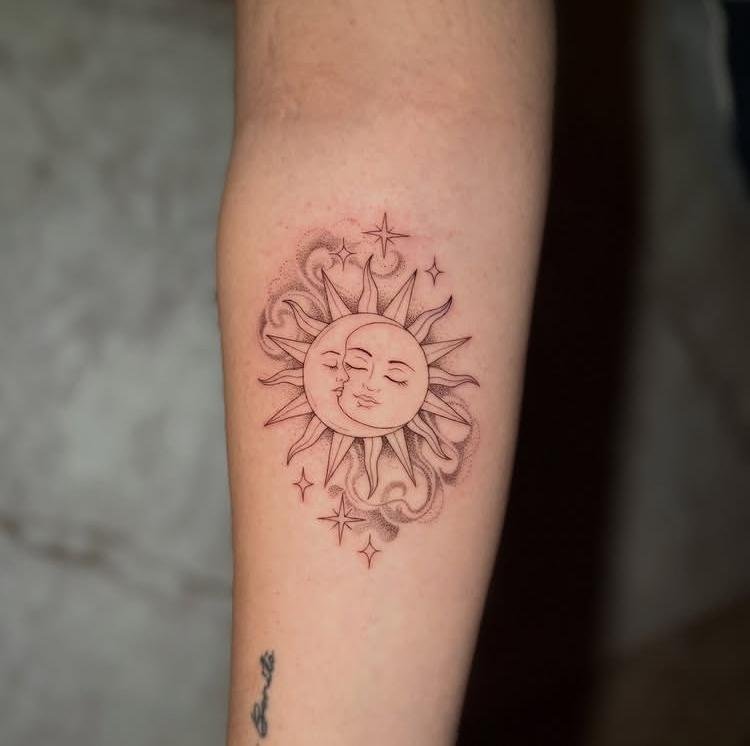
Dreamy Duo Forearm
Two celestial faces meet in a single forearm design, with clouds and small stars softening the space around them. The joined composition feels like a small illustrated scene: the sun and moon remain distinct, yet share one outline and one visual center.
Ask your artist to keep the facial features simple enough to read at the size you want. The forearm gives a longer area for the clouds and star accents, but you can trim those details if you prefer a cleaner focal point.
Quiet Descent
An arrow, a star, a sun, and a crescent follow one slim line down the ankle. The sequence suggests a shift from daylight to night without relying on a large background. Its narrow shape makes the design feel like a small vertical keepsake.
Before choosing the order, decide whether you want the symbols to tell a story or simply create a pleasing rhythm. Ask the artist to place the stencil while you are standing so the line follows the leg naturally and does not twist when you move.

Smoke and Crescent
A dark crescent and an open sun sit inside loose, ribbon-like lines on the upper arm. The shifting curves keep the design from looking rigid, while the dark and open shapes give the eye a clear contrast. It has a modern, sketch-like feel.
Negative space is doing much of the work here. Ask the artist to leave enough room between the crescent, sun, and surrounding lines so the shapes stay separate at the final size. A stencil preview can show whether the curves suit your arm from more than one angle.

Phases on Display
A sun at the center of a row of moon phases creates a balanced, horizontal composition. The repeated shapes give the design an orderly rhythm, while the central sun keeps it from reading as a plain sequence. It can make a longer thigh placement feel intentional.
If the phases represent a real lunar cycle for you, check their order before the appointment; NASA explains how the Moon’s sunlit appearance changes through its phases. If the pattern is decorative, tell your artist that accuracy is not the main goal and focus on spacing and scale.

Sun Meets Crescent
A small crescent nestles beneath a radiating sun, with one tiny star finishing the composition. Because the two symbols overlap only slightly, each remains easy to recognize. This is a useful reference if you like a celestial tattoo but do not want a dense cluster.
The upper arm gives the motif a little more room than a tiny wrist design. Your artist can adjust the ray length, crescent opening, and star placement to suit the exact spot. Keep the smallest marks open rather than packing them tightly together.

Bold Spiral Union
Spiral details fill the center of the sun and moon, while dots add texture around the pair. The stronger lines create a grounded, graphic look that stands apart from fine-line celestial designs. It works best when the spirals remain the clear focal point.
This design has more visual weight than a simple outline, so decide whether you want a compact emblem or a larger piece with breathing room. Ask to see a stencil at its real size and check that the dots and curls remain distinct rather than merging into one dark area.

Vertical Phase Line
A sunburst anchors a vertical line of moon phases, creating a tall, symmetrical layout. The repeated shapes help guide the eye from one end to the other, making it a natural reference for a longer area such as the shin or forearm.
A long design can look different when viewed from the front, side, or above. Ask your artist to check the alignment while you stand in a relaxed position and choose the direction that matters most to you. NASA’s phase guide is useful if you want the sequence to follow the real cycle.

Wrist-Bound Eclipse
The sun and crescent overlap in a compact wrist design, with a few stars placed below the main shape. Their close arrangement suggests an eclipse without requiring a large circular background. The result reads like a small celestial charm rather than a full scene.
Wrist skin moves whenever you bend your hand, so look at the stencil with your wrist relaxed and flexed. Check how the design sits beside a watch or bracelet, then let the artist adjust the width so it remains comfortable with your everyday accessories.

Celestial Yin-Yang
A circle divides a dotted night sky from a bright sunburst, borrowing the visual balance of a two-part emblem. The dark and light sections create contrast, while the circular edge gives the design a tidy boundary on the shoulder.
Treat this as a celestial composition with a yin-yang-inspired layout, not as a substitute for a symbol with a specific cultural or religious meaning. If that distinction matters to you, discuss the design language with your artist and choose the shapes, marks, and colors with care.

Faces of Day and Night
Two expressive faces share a crown of rays, with small dotted drops beneath them. This illustration-led idea gives the sun and moon distinct personalities, so it feels more like a tiny story than a simple symbol pair.
Facial features and tiny marks need enough room to remain clear. Ask the artist which details should be simplified if you want a smaller tattoo, and decide whether the faces should look toward each other or face outward. A forearm or upper arm offers more space than a narrow wrist.

Compass-Point Sun
A dotted sun face sits inside a compass-like frame, with small points and stars extending from the circle. The design combines celestial imagery with a directional motif, giving the piece a more structured look than a free-floating sun and moon.
Pick the compass details that are meaningful to you and leave out any letters or points that are only decorative clutter. A clean center, even spacing, and consistent line weight will help the design stay legible. Bring a reference of the frame you like, then let your artist redraw it for the chosen placement.

Held in Balance
A hand holds the sun and moon on a fine line, suggesting a deliberate balance between the two shapes. The spare layout keeps attention on the central idea instead of filling the arm with extra clouds or stars.
If the hand is meant to feel gentle or protective, decide whether it should be realistic, simplified, or drawn as an outline. The inner forearm gives the vertical line room to breathe, and a stencil can help you check whether the hand and symbols feel proportionate together.

Wavy Rays and Sparkle
Curved rays flow from the sun toward a crescent, while small sparkle marks and a trailing line bring movement to the arm. The design feels less geometric than a straight phase sequence and more like one continuous celestial flourish.
Choose whether the wavy line should travel along the arm or angle across it. Ask the artist to keep the rays and sparkles secondary so the main sun-and-moon connection stays easy to see. You can remove a few small accents without losing the idea.

Live by the Sun
A tiny sun and moon sit beside looping script that curves down the arm. The words carry the message, while the symbols act as visual punctuation. This approach can make a personal phrase feel more distinctive than lettering by itself.
Use wording you are certain you want to keep, and check spelling, punctuation, and letter shapes before the stencil goes on. Ask the artist to show the complete phrase at the planned size; if the words look cramped, shorten the text or choose a larger placement.

Hands That Hold Light
Two simple hands cradle a sun and a crescent, leaving open skin around the central symbols. The mirrored gestures create a calm, balanced composition that can read as care or connection if that is the meaning you assign to it.
The hand outlines should stay clear without becoming overly detailed. Ask your artist to adjust the finger shapes and space between the symbols for the size you want. An upper-arm placement provides more room for the gesture than a very small area near the wrist.

Tide and Twilight
A crescent sits within sunburst rays above one flowing wave, bringing sky and water into a compact design. The wave gives the celestial pair a grounded base, so the tattoo can suggest a coastal memory without turning into a full landscape.
Decide whether the water should be one simple line or several small ripples. The wrist can suit a compact version, but the artist should position the stencil where the curve remains visible when your arm rests naturally. Leave enough space between the wave and the symbols.

Dotted Drip Detail
A crescent rests inside a sunburst while dotted drops hang below the main shape. The dots add texture and create a gentle downward flow, giving a familiar celestial pairing a more ornamental finish.
Ask the artist to vary the dot size only if the overall style calls for it; too many tiny marks can distract from the central shapes. A forearm placement allows a little extra length for the drips, while the top portion can stay compact and easy to recognize.

Two Faces, One Sky
A sleeping sun and a crescent moon in profile are stacked vertically, with calm expressions giving the design a storybook mood. The two faces do not need to touch; matching line weight and spacing can make them feel connected.
Choose which face sits above the other based on how you want the tattoo to read when your arm is at rest. If the design is small, ask the artist to simplify eyelashes, lips, and other fine features. A forearm can keep the pair tall without crowding the details.

Cloud-Wrapped Crescent
A crescent is framed by light clouds inside a sunburst, with small stars arranged around the edge. The clouds soften the pointed shapes and make the design feel more like a miniature sky than a simple emblem.
Keep the cloud outlines open enough to separate them from the crescent. If the tattoo will be small, your artist can reduce the number of stars or simplify the rays so the main outline remains the first thing people notice.

Diagonal Balance Line
A slim diagonal line passes through a small sun-and-moon emblem, with a star above and a tapered end below. That single axis gives the composition direction and keeps the symbols from appearing as separate stickers.
Try the stencil at more than one angle before settling on the design. A diagonal can follow the forearm’s natural line or cut across it for a more graphic look. Choose the direction that feels intentional to you when you look down at your arm.

Wrist Sunset Crescent
A shaded crescent is surrounded by thin sun rays at the wrist. The contrast between a softly filled moon and open rays creates a warm, slightly vintage look without needing color or a large background.
Ask whether the shading should be smooth, dotted, or left mostly open. The answer depends on the size and style you want, so review the artist’s healed examples rather than judging only a fresh tattoo photo. Check the stencil beside any bracelets you wear often.

Scattered Across the Collarbone
A tiny sun rests near the collarbone, a crescent sits closer to the shoulder, and small stars connect the two. The scattered arrangement feels like a small patch of sky rather than a single centered badge.
The collarbone area changes with posture, so ask the artist to position each element while you stand naturally. Decide how far the design should extend toward the shoulder and how it will sit with necklaces or open necklines before approving the stencil.

Face Behind the Eclipse
A woman’s profile is drawn into the outline of a sunburst and crescent, making the face part of the celestial shape rather than a separate portrait. Unbroken contour lines keep the design clean and graphic.
This idea depends on the profile remaining recognizable at the final scale. Ask the artist to show which facial lines can be kept and which need simplifying. A slightly larger upper-arm placement may leave more room than a tiny version close to the wrist.

Full Phase Halo
A sunburst anchors a circle of moon phases, creating a halo-like composition with a clear center. The repeated crescents and gibbous shapes make this one of the more detailed designs in the set, while the circle keeps the overall form contained.
Confirm whether you want a scientifically ordered phase sequence or a decorative ring. NASA’s moon-phase guide shows how the illuminated portion changes during the roughly 29.5-day cycle; use it as a reference if accuracy is part of your idea. Ask your artist to leave enough space between each phase.

Starlit Ankle Emblem
A crescent curls into a small radiant sunburst at the ankle, with dotted rays adding a light, jewelry-like finish. This compact idea keeps the main shapes close together, so it can work when you want one clear symbol rather than a long celestial scene.
Because the ankle is a compact placement, decide which details matter most before the stencil is drawn. Ask your artist to test the design beside the ankle bone and with your usual footwear in mind. A little extra spacing can make the crescent and rays easier to distinguish.

How to Plan a Sun and Moon Tattoo
A strong reference gives your tattoo artist a direction, then leaves room for a custom drawing. Save the parts you like—the crescent angle, the ray style, or the balance between dark and open shapes—and explain what you want changed. This makes the consultation more useful than asking for an exact copy.
Choose one clear focal point
Decide whether the sun, moon, faces, or a shared circle should catch the eye first. If every star, ray, cloud, and line is equally prominent, the design can feel crowded. A single focal element with supporting details often reads more clearly at a glance.
Pick a composition before a meaning
Some people connect the pair with day and night, different sides of a relationship, or balance. Others choose it for the visual contrast. Treat those associations as possibilities, not rules. If a personal story matters to you, write it down and let that guide the final symbols.
Check the phase sequence if accuracy matters
A decorative row of crescents does not have to represent astronomy. If you want a real lunar sequence, use NASA’s moon phases guide to check the order. NASA describes a complete phase cycle as about 29.5 days; the visible shape changes as the Moon orbits Earth and we see different portions of its sunlit half.
Test the tattoo at its actual placement
Ask your artist to position the stencil while you stand or sit naturally. Turn your arm, bend your wrist, and check the design in a mirror if it will sit on the shoulder, collarbone, or ankle. Think about clothing, jewelry, and how often you want the tattoo to be visible.
Plan for safe tattooing and aftercare
A tattoo is permanent, and the FDA reports that contaminated inks can cause infections and that some people have allergic reactions. Review the FDA’s tattoo safety guidance, ask the studio about hygiene and ink handling, and follow the artist’s healing instructions. Once healed, the American Academy of Dermatology advises broad-spectrum, water-resistant SPF 30 or higher to protect tattooed skin from the sun; see its tattooed-skin care tips.
If you are comparing other celestial motifs, browse our simple moon tattoo ideas and angel tattoo ideas for more design directions.
Sun and Moon Tattoo FAQs
What does a sun and moon tattoo mean?
It can represent balance, contrast, a relationship, or a personal connection to the sky. The meaning is individual; the design does not have to carry a set message.
Where can I place a small sun and moon tattoo?
The wrist, ankle, forearm, and upper arm can all suit a compact motif. The best fit depends on the line detail, visibility you want, and how the design sits on your body. Ask for a stencil preview before the session begins.
Should the sun and moon face each other?
They can face each other, share one circle, or sit separately. Choose the arrangement that makes the design feel balanced to you, then ask the artist to test its direction from the angle you will see most often.
Can a sun and moon tattoo include all moon phases?
Yes. You can make the phases a decorative border or arrange them in the astronomical sequence. If accuracy matters, check the order against NASA’s moon-phase reference before your artist finalizes the design.
Final Thoughts
A sun and moon tattoo can be a quiet pair of symbols or a detailed scene. Start with the shapes you want to keep, choose a placement that gives them room, and ask your artist to redraw the reference for your body. A clear focal point and thoughtful spacing can make the finished piece feel personal without adding details just to fill space.
Pingback: Behind the Ear Tattoo Ideas: 25 Tiny Designs to Save