
Mom tattoo ideas can be a small everyday reminder, a family tribute, or a memorial design for someone you miss. A tattoo does not need a universal symbol to be meaningful; a detail from your own life can carry more weight than a popular image. These 25 ideas cover different styles, from handwriting and flowers to portraits, animals, and classic heart designs.
Use them as starting points, then make the artwork specific to your relationship. Think about the words you want, the artist’s style, and how much space the design needs before you book a session.
25 Mom Tattoo Ideas That Tell a Personal Story
1. A Hand to Hold
A simple drawing of a mother’s hand holding a child’s hand can stand for care without needing a name or a long quote. It can be drawn from a family photo, a child’s small handprint, or a moment you remember clearly. The idea works for a living mom or as a memorial tribute.
Choose the hands and pose that reflect your story instead of using a generic stock drawing. Bring a clear reference image to the consultation, and ask the artist to preserve the main gesture while removing tiny details that would crowd the final size.
If you have a photo of your hands together, choose one where the fingers are easy to see and the background is plain. The artist can use it as a guide rather than tracing every crease, which helps the final lines stay clean and personal.

2. Connected by a Red Thread
A red line joining two figures can suggest a bond that continues across distance or change. The thread may loop between two wrists, connect two small hearts, or sit beside initials. Its meaning is yours to define; different cultures and stories use red-thread imagery in different ways.
Keep the line and figures simple enough to read at a glance. If the design includes names or dates, check the spelling and order together before the stencil goes on. A small color accent can be powerful without covering the whole composition in red.
The red thread is a visual idea, not a rule about what a relationship should mean. You can change the color, direction, or objects attached to it. If you plan to include a cultural symbol, learn its background and decide whether it belongs in your own story.

3. A Watercolor Motherhood Moment
Soft color around a mother-and-child image can make the tattoo feel like a memory or a page from a family album. Choose a real moment—walking together, holding a baby, or sharing a quiet hug—so the image reflects your relationship rather than a generic idea of motherhood.
Watercolor-style work varies from artist to artist. Review healed examples from the tattooer you are considering and discuss how the design will be outlined, shaded, and sized. A digital preview can help you compare colors, but ask the artist how the final work will translate to skin.
Watercolor details can be soft and loose, but the artist may use a defined outline to keep the figures readable. Ask what will be outlined and what will remain color only. That conversation can help you choose between a painterly look and a more graphic illustration.

4. A Heartbeat Line for Mama
A heartbeat line with the word “Mama” combines a direct message with a simple graphic. You can add a small heart or a date, or keep the line clean so the lettering remains the focus. The design may be a tribute, a family nickname, or a reminder of a personal milestone.
Do not describe a decorative heartbeat as a medical record unless it comes from a verified source and you have permission to use it. If you want an actual ECG trace, confirm whose information it represents and bring an accurate copy. Otherwise, use a clearly stylized line.
A stylized heartbeat line is usually a decorative mark. If you want a real medical tracing, verify that the record belongs to the person whose heartbeat it shows and ask permission before using it. Keep the line uncluttered so the word remains easy to read.

5. Flowers and Dates for a Mom Tribute
A flower can frame the dates that matter to your family, such as a birthday, adoption day, or a date of remembrance. Choose a bloom connected to your mom’s garden, favorite season, or personal taste rather than assuming each flower has one universal meaning.
Write the date in a format you will understand years from now. Spell out the month if numbers could be read in different orders. Ask the artist to leave space between the lettering and petals so the tattoo stays easy to read.
If you choose a birth flower, check the month and the plant name from a reliable source before adding it to the design. Some months have more than one flower association. You are also free to choose a bloom because your mom grew or loved it.

6. Side by Side With Mom
A mother and child drawn walking side by side can capture a familiar routine: a school walk, a weekend stroll, or a path you took together. It can be adapted for an adult child by changing the figures’ heights or clothing. A small horizon or plant can set the scene.
Use a photo that shows the body language you want, but do not try to reproduce every background detail. The figures should remain the center of the design. Ask to see the stencil at full size and check that the pose still reads clearly from a few feet away.
For a walking scene, decide whether the tattoo should show faces, profiles, or only silhouettes. A side view can make the shared direction clear while keeping the people less identifiable. Let the artist adjust the height and spacing to suit the size of your arm or leg.

7. A Fingerprint Heart for Mom
A heart made from a fingerprint can feel personal because the pattern is tied to one person. You might use your own print, your mom’s print with permission, or two partial prints arranged together. A simpler fingerprint-inspired swirl is another option if you do not want to reproduce an exact biometric pattern.
Keep the original print secure and share it only with the artist you choose. Fine ridges may be hard to preserve in a small tattoo, so discuss size and clarity before deciding. The artist can simplify the pattern while keeping the heart shape recognizable.
Fingerprints contain identifying detail, so do not upload a clear print to a public design generator or share it more widely than needed. You can ask the artist to work from a cropped image and delete it after the design is finalized if privacy matters to you.

8. A Portrait Framed With Flowers
A portrait surrounded by flowers can combine a likeness with details that recall your mom’s favorite garden or a family tradition. It can be realistic, illustrative, or a simplified line drawing. If you prefer not to use a face, a familiar hairstyle, glasses, or silhouette can suggest her without a full portrait.
Portrait work depends heavily on the artist’s experience and the quality of the reference photo. Look at healed portraits in the style you want, not only fresh work. Choose a clear, well-lit original photo and give the artist room to simplify the surrounding flowers.
Ask for a drawing preview and discuss what can be changed before the appointment. The artist should explain how the face, hair, and flowers will be simplified at the selected size. A portrait that feels recognizable to you is more important than a decorative frame packed with detail.

9. Held Beneath the Sun
A mother and child under a sun can suggest warmth, protection, or an outdoor memory. The sun might be a plain circle, a small halo of lines, or a setting sun behind the figures. You can keep the image abstract so it feels personal without needing a detailed portrait.
Avoid adding too many rays, clouds, and small figures if you want a compact tattoo. Ask the artist which lines should stay open and how the circle will sit on the chosen body area. The design should still look balanced when the skin moves.
You can make the scene less literal by showing two silhouettes beneath a simple sun instead of adding facial features. A small ground line or a few rays may be enough to complete the composition. Keep open skin around the figures so they remain the first thing you notice.
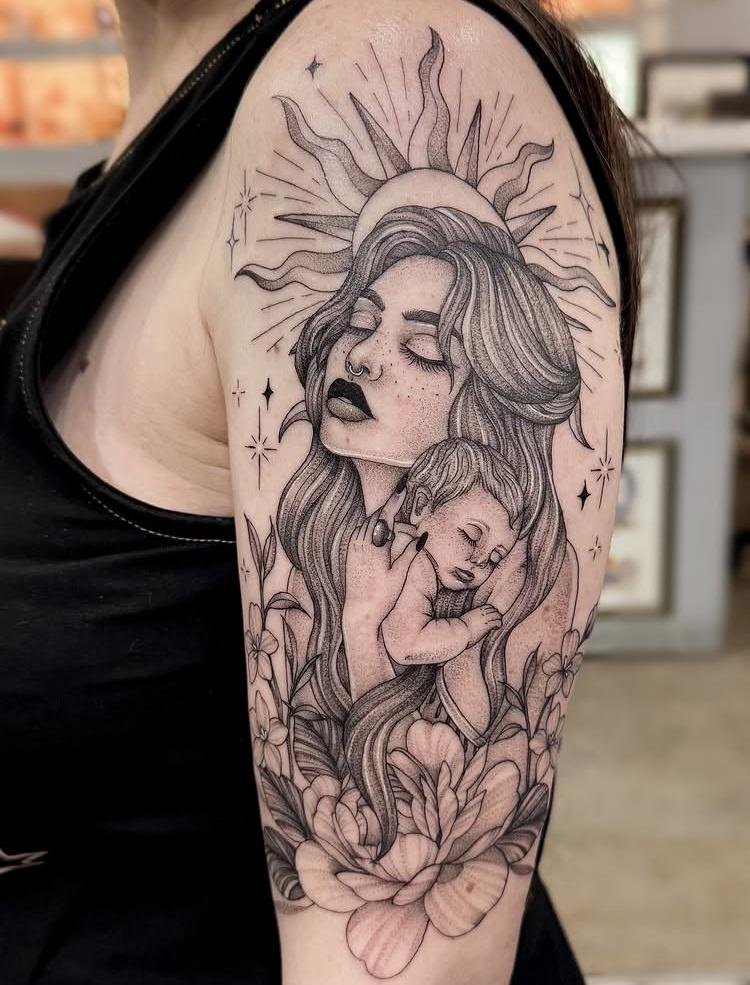
10. A Quiet Motherly Embrace
An embrace can say more than a label or quote. A close outline of two people holding each other works as a tribute to a living mom, a memory of a loved one, or a representation of a chosen family relationship. Keep the posture and scale meaningful to your own experience.
If the image is based on a photograph, choose one with clear outlines and a pose you are comfortable having on your body. Discuss whether faces should be visible or left abstract. A silhouette can protect privacy while keeping the gesture recognizable.
The embrace can be drawn from behind, which avoids difficult facial details and can still feel intimate. A small difference in height, hairstyle, or clothing may make the figures resemble you and your mom. Share those cues with the artist before the sketch is finalized.

11. A Traditional-Style Family Embrace
Bold outlines and a limited color palette give a family embrace a classic tattoo look. This approach can work if you like strong shapes and readable lettering. A small banner can carry a name, “Mom,” or a short date, while the people remain the center of the composition.
Bring examples of the specific traditional style you like, since line weight and color choices vary. Ask the artist how much space the design needs and whether the banner lettering will remain clear. Do not force a small phrase into the artwork if the layout becomes cramped.
Traditional work often uses confident outlines and solid color. Ask whether your artist would keep the skin breaks open or fill the heart and banner more heavily. Looking at healed examples helps you choose a version that matches the style you will enjoy for years.

12. A Soft Kiss With Blue Florals
Blue flowers around a mother and child can make a tender scene feel more distinctive than a standard heart. The flowers could be a favorite bloom, a color your mom loves, or simply part of the art style. You can use a kiss, forehead touch, or another gesture that fits your family.
Color references on a screen do not always match healed ink. Ask the artist to talk through the palette and show healed work in similar shades. Keep the faces and floral details separated so each part remains visible rather than blending into one patch.
Blue flowers do not need to represent a particular emotion. Choose a shade because it is your mom’s favorite or matches the colors in a meaningful place. If the composition includes faces and petals, ask the artist to keep a clear boundary between the colored shapes.

13. A Lioness and Cub
A lioness with a cub can represent a protective relationship or a shared love of wildlife. The imagery does not have to carry a fixed meaning; it may simply remind you of your mom’s personality or a story you tell about each other. A minimal silhouette and a detailed illustration are both options.
If you choose a realistic animal portrait, seek an artist whose healed animal work matches your preferred style. Bring reference photos of the species and pose you want. Avoid squeezing two detailed faces into a tiny space; a larger silhouette may communicate the idea more clearly.
If you want the lioness and cub to feel like a real species, use a clear reference for the animal and the pose. You can also choose a stylized pair with fewer details. Both approaches can work; the important choice is whether you want a literal wildlife image or a family metaphor.

14. Mom With Angel Wings
Angel wings can be used as a memorial image or as a spiritual symbol, but the idea is not limited to one belief. Some designs place the word “Mom” between the wings; others use the wings around a flower, date, or small heart. Decide what the symbol means to you before adding text.
If the tattoo is memorial, take time to choose the words and details that feel right. A simple name or date can be enough. For a religious image, check the intended symbolism and design with someone you trust rather than relying on an online caption.
Angel wings may read as a memorial or religious symbol to some people, while others see them as a design element. You can add a name, initials, a favorite flower, or nothing at all. Choose the details that communicate your intention without feeling obligated to explain it.
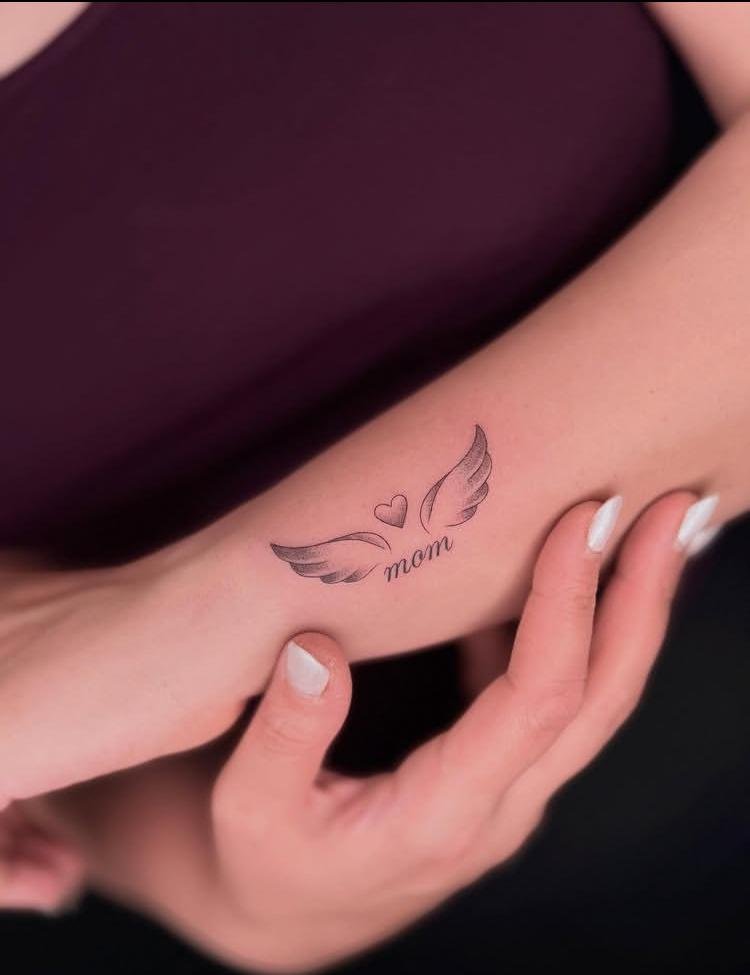
15. A Mama Duck and Her Little One
A mama duck walking with a duckling is a gentle alternative to a human portrait. It can reflect a family nickname, a favorite children’s book, or a playful way to represent a parent and child. The figures can be small and simple or placed in a broader scene with a few reeds.
Make sure the ducklings and their spacing stay clear at the final size. A few body shapes will often read better than tiny feathers and facial lines. Ask the artist to test whether the pair needs a little more room on your chosen placement.
This idea can be playful with rounded shapes or more natural with fine outlines. Decide which mood suits your family. If the ducklings represent children as well as a mother, count the figures carefully so everyone is included and the design does not become crowded.

16. Together on a Crescent Moon
A mother and child sitting on a crescent moon creates a dreamy scene that can be tailored to a family’s style. Use a clean outline for a quieter look, or add a few stars that connect to a personal memory. The moon does not need to signal any fixed message beyond what you choose.
Small figures on a curved shape can lose definition if their outlines overlap. Ask the artist to keep the bodies and moon distinct, then view the stencil from different angles. If you want names or dates, consider placing them outside the main illustration.
The crescent can face upward, downward, or sideways depending on the way the figures sit. Test the stencil in your preferred orientation while standing and sitting. Small stars can complete the scene, but you may not need them if the curve already frames the people clearly.

17. An Old-School Mom Heart
A heart with “Mom” across a banner is a familiar American tattoo motif. It can be done in a bold traditional style or simplified into a smaller outline. You can personalize the banner with your mom’s actual nickname, a flower, or a color that feels connected to her.
Because the banner is the focal point, check the lettering carefully. Make sure the word is spelled and capitalized as you want it. Ask the artist how large the heart needs to be for the banner to remain legible and for the lines to heal with space.
A traditional heart can be colorful and bold or reduced to black linework. If the banner includes a nickname instead of “Mom,” check that the letters fit without shrinking too much. The wording should remain the focal point, even when you add a rose or other ornament.

18. A Lace-Trimmed Heart for Mom
A lace-like border can give a heart tattoo a softer, vintage feel. The center could hold a name, a small flower, or a handwritten initial. This is a good option if your mom loved sewing, keepsakes, or decorative details, or if the style simply fits your own taste.
Lace contains many small marks, so it needs enough room. Ask the artist to simplify repeated loops and leave open space around the center. A clean border can preserve the handmade look without making every stitch part of the tattoo.
Lace-inspired marks should be simplified by an artist who understands how much detail the chosen size can hold. Ask which loops can be widened or removed. A few repeated scallops can suggest a lace edge without creating a dark, tight pattern around the heart.

19. A Classic Heart and Banner Tribute
A heart-and-banner design can be adapted to honor a mother with her name, “Mom,” or a short phrase. It can also pair with a small rose or another flower if that suits the story. A classic layout is easy to recognize, but the details can still be custom.
Keep the lettering brief and check the layout before the appointment. The banner should not fold across important parts of the heart, and any extra flower should have enough space to read as a separate shape. Ask to see the stencil at the intended size.
You can personalize the banner with a name, a short note, or a date, but avoid adding all three if they compete. Make sure the ribbon has enough width for the letters and that the heart remains visible behind it. Review the complete stencil before approving any ink.

20. An Elephant and Calf With Florals
An adult elephant and calf can represent a family bond when that imagery feels meaningful to you. A few flowers can soften the outline or connect it to a family garden. The animals can be realistic or simplified; choose the version you would enjoy seeing every day.
Elephants have many meanings across cultures, so avoid treating one interpretation as universal. If you want to reference a specific cultural or religious symbol, learn its context first. For the artwork itself, keep the trunks and ears recognizable and avoid crowding them with small petals.
Elephant imagery appears in different cultural and religious contexts, so research a specific symbol before using it as decoration. If your idea is simply a parent and baby animal, keep the composition focused on the pair. A few leaves can frame them without obscuring the animals.

21. A Memory Collage in Ink
A small collage can bring together a few pieces of your mom’s story: a flower, a favorite object, a handwritten word, and a date. You might also choose a family photo as the central reference. The collage works best when the elements share a visual style rather than competing for attention.
Choose two or three details instead of trying to include an entire biography. Bring the artist separate clear references, explain why each item matters, and let them suggest a layout with negative space. A focused collage will usually be easier to read than a crowded collection of symbols.
A collage can have one main image, such as a flower or portrait, with two smaller references around it. This gives the eye a place to land. Tell the artist which object matters most and which details are optional if the design needs to be simplified.

22. Mom Between Angel Wings
Placing a name or short word between a pair of wings can make the tribute easy to recognize. You can choose a more traditional feathered style, a simple outline, or abstract wings built from a few sweeping lines. Add a date only if it has a clear place in your story.
Wings may suggest religious ideas, remembrance, freedom, or something else depending on the person. Choose the interpretation that fits you. If the feathers are very detailed, give the design room; the artist can remove small marks that would otherwise blur together.
Wings can be designed as a full pair, a small outline, or a partial frame around the word. Consider whether you want the memorial meaning to be clear to other people or private to you. Either choice is valid; the artwork does not need to explain your grief.

23. Wrapped in an Owl’s Wings
An owl’s wings folded around a figure can create a protective image with a different feel from angel wings. The owl might connect to a favorite animal, a family story, or a night spent outdoors. You can also replace the owl with another bird that matters more to your mom.
Ask the artist to keep the face, wing edges, and central figure distinct. A reference image can help show the posture, but a custom drawing should fit your chosen size. Do not add too many feathers if the main embrace is the part you want people to notice.
An owl can be drawn with open wings, folded wings, or a simple feather shape around the central figure. Choose an owl reference that matches the look you want rather than relying on symbolic claims from a generic chart. Keep the face visible if recognition matters.

24. An Unforgettable Embrace
A close embrace can represent a specific goodbye, reunion, or ordinary moment you never want to forget. If the tattoo is in memory of someone who has died, you may want a small date or object from that day; if she is living, the same idea can celebrate a moment you shared.
You do not need to decide on a memorial tattoo quickly. Choose a reference you feel comfortable keeping and consider whether the image still feels right beyond the current moment. Ask the artist to make the figures recognizable without relying on tiny facial details.
If your reference is a family photograph, ask the artist which parts translate best to tattoo art. A clear outline, recognizable clothing, or a distinct posture may matter more than tiny details. You can also make the scene symbolic rather than reproducing the photo exactly.

25. Mama With Flowers and a Butterfly
Flowers and a butterfly can form a bright tribute without using a portrait. Choose a flower from your mom’s garden, a butterfly from a trip, or colors she enjoyed. This can work as a small tattoo or grow into a larger composition if you want more room for leaves and wings.
Butterfly and flower designs are common, so add one detail that makes yours specific: an unusual stem, a favorite bloom, or a handwritten initial. Ask the artist to keep wing markings and petals spaced far enough apart to stay clear after healing.
The butterfly can sit above a flower, follow a stem, or form part of a larger frame. Ask the artist to keep its wing pattern distinct from the petals. One unusual detail, such as a favorite flower or a small handwritten initial, can make the design feel less generic.

How to Choose a Mom Tattoo
Begin with the story you want the tattoo to hold. It might be a phrase your mom used, an ordinary routine, a family recipe, a place you visited, or a quality you admire. Write down a few details before choosing an image. This helps you move beyond a design that looks meaningful in a photo but has no connection to your life.
- Decide whether it is a tribute or a memorial. The artwork can honor a living mom, remember someone who has died, or celebrate your own experience of motherhood. Choose words that fit the situation instead of assuming every mom tattoo is a memorial.
- Pick the style before the subject grows too detailed. Fine-line, traditional, watercolor, and realistic work need different skills. Review healed work by artists who specialize in your preferred style.
- Use personal references thoughtfully. Bring a clear photo, note, handwriting sample, or family object if you have permission to use it. Tell the artist what matters most so they can focus the design.
- Keep the final choice yours. You can appreciate a trend and still change it. A simple design with a personal detail can be more meaningful than adding every familiar symbol.
Placement, Safety, and Aftercare
Choose a location based on visibility, clothing, movement, and the size the artwork needs. A portrait or several words often need more space than a simple heart. Try the stencil in your usual posture and look at it from different angles before giving final approval.
A tattoo breaks the skin. The U.S. Food and Drug Administration warns that contaminated ink can cause infection and that reactions to inks can occur. Review its tattoo safety guidance and check local health requirements when choosing a studio. Follow the tattooer’s aftercare directions and contact a health professional if you are worried about a reaction.
After the tattoo has healed, protect exposed skin from the sun. The American Academy of Dermatology says ultraviolet light can fade some tattoo inks and offers advice in its guide to caring for tattooed skin.
FAQs About Mom Tattoo Ideas
What is a meaningful tattoo to get for your mom?
A handwritten word, a flower tied to a family memory, a portrait, a shared object, or a small scene from your life together can all feel meaningful. The best choice is the one that reflects your relationship, not a symbol you feel expected to use.
What are good small mom tattoo ideas?
A short word, simple heart, small flower, date, or clean outline can work at a smaller scale. Ask an experienced artist to show the design at its actual size and remove details that do not have enough room.
Can I get a mom tattoo if she is still alive?
Yes. A tribute tattoo can celebrate a living person, a shared memory, or your relationship. You might include her handwriting or ask what personal detail she would enjoy seeing, if you want to involve her in the choice.
What should I include in a memorial tattoo for my mom?
You could use a name, date, handwriting, favorite flower, treasured object, or a scene that reminds you of her. There is no required symbol or timeline. Take the time you need and choose an image that feels right to carry.
How do I choose an artist for a portrait tattoo?
Look for healed portrait work in the style you want and ask about the artist’s experience with the size and placement you have in mind. Bring a clear reference image and discuss which facial or personal details should remain recognizable.
A mom tattoo can be quiet, colorful, traditional, or highly personal. Give the design time to take shape, choose an artist whose healed work you trust, and approve the stencil before the session. For more family-focused inspiration, explore our mother-daughter tattoo collection and mother-son tattoo ideas.