
Looking through evil eye tattoo ideas? The eye motif can be minimal, ornamental, colorful, or part of a larger piece with flowers, celestial details, or geometric lines. This gallery gathers 25 different looks, with notes on scale and placement so you can decide which parts suit your personal style.
People use “evil eye” to describe related symbols, but meanings are not identical everywhere. The American Academy of Ophthalmology Museum notes that eye symbols have culture-specific uses, with protection, healing, and enlightenment appearing as recurring themes. The museum’s overview of eye signs and symbols is a helpful starting point.
An eye-shaped charm, a hamsa hand, and an Eye of Horus are not interchangeable just because each may include an eye. If a design draws from a specific religious or cultural tradition, learn about that form before choosing it. Some people select the motif for a belief or family connection; others like its shape or color. A tattoo expresses a person’s meaning, but it should not be presented as a guaranteed way to prevent harm.
Understanding the Symbol and Its Context
Blue concentric eye beads are one familiar form associated with the nazar tradition, while other eye symbols appear in different historical and religious settings. A hamsa is a hand-shaped motif with its own context; for example, it is known in some Jewish communities as the Hand of Miriam and in Muslim communities as the Hand of Fatima. These names and meanings are tied to distinct traditions, so avoid treating every eye or hand design as one universal symbol.
If cultural meaning is part of why you want the tattoo, identify the specific tradition and source you have in mind. If you are drawn mainly to the visual, you can still choose thoughtfully by understanding what the design resembles and how it may be read by others. Personal significance and cultural history can coexist, but neither needs to be overstated.
25 Evil Eye Tattoo Ideas
Use the gallery to compare shape, color, and scale. The designs move from compact blue eyes to detailed blackwork, hamsa forms, floral accents, and celestial frames. The credit under each image links to the available source reference; the images themselves are not linked.
1. An Eye Framed in Ornament
A bright blue eye sits at the center of an elaborate ornamental frame. Dark curves and fine marks give the piece depth, while the colored iris remains the strongest point of focus. This is a statement design with a clear center, not a barely-there symbol.
The frame needs room around the eye so its edges do not merge into one dark shape. Ask the artist to set the eye size first, then build the decorative lines outward. An actual-size stencil can show how much forearm or shoulder space the finished piece will use.

2. Brushstroke Blue
Loose blue strokes and splattered edges suggest an eye without drawing every line precisely. The painterly approach makes the familiar motif feel more like a small abstract artwork than a crisp, round charm.
This style depends on choosing which marks define the eye and which remain expressive texture. Review the composition at the intended size and ask how the blue will be separated from the skin. A few intentional strokes can keep the design lively without making it hard to read.

3. Tiny and Straight to the Point
A small blue eye near the wrist keeps the motif simple and direct. Its compact shape can look like a tiny charm beside a watch or bracelet, and the clean design avoids extra decoration.
Tiny tattoos have limited room for narrow rings and small color bands. Ask your tattooer to show the final size on skin and simplify any lines that need more space. If you wear a watch, check that its edge will not cover the part of the symbol you want to see.

4. A Secretive Behind-the-Ear Detail
This miniature blue eye sits behind the ear, where hair can cover it or reveal it when pulled back. The placement makes a simple motif feel personal and subtle without needing an elaborate frame.
The area is small, so keep the design readable and talk through how hair, glasses, and ear shape affect the exact position. For more tiny placement inspiration, see our behind-the-ear tattoo ideas.

5. A Darker, More Expressive Eye
Bold black shapes, blue and gold tones, and teardrop-like details give this eye a moody, illustrated look. Rather than resembling a simple amulet, it reads as a small surreal artwork with a strong gaze.
Decide whether the eye or the surrounding shapes should lead. If you prefer a less intense version, reduce the darkest marks or keep only one accent color. A clear focal point helps a complex design remain balanced on a smaller area.

6. The Most Delicate Ankle Bracelet
A fine band wraps around the ankle, with small blue accents among darker bead-like details. The jewelry-inspired layout feels understated and makes the eye motif part of a continuous pattern rather than a single centerpiece.
An ankle band should be checked from all sides so the design joins cleanly around the leg. Think about where shoes and socks may sit, and ask the artist to leave breathing room between tiny marks. For other ankle placement options, browse our small ankle tattoo ideas.

7. Ornamental and Perfectly Balanced
A detailed blue eye is framed by decorative flourishes above and below. The repeated curves create a vertical, symmetrical shape, and the blue accents connect the eye to the surrounding ornament.
Symmetry makes the centerline especially important. Try the stencil while the arm rests naturally and check that the design does not appear tilted from the front. If the linework feels too ornate for your style, keep the center and remove a few outer flourishes.

8. A Celestial Evil Eye Moment
A bright blue eye sits inside a light starburst made from fine lines, dots, and tiny celestial details. The vertical layout leaves open space around the main motif, giving the design an airy, constellation-like feel.
Let the eye stay visually distinct from the rays and stars. A compact layout can work on the forearm or upper arm, but make sure the smallest dots have enough spacing at the final size. Keep the celestial accents selective so the center remains easy to recognize.

9. Classic Hamsa With a Pop of Blue
A fine black outline forms a hand-shaped hamsa, while a vivid blue eye becomes its focal point. The compact composition combines the eye with a second recognizable symbol, creating a decorative piece with a clear silhouette.
A hamsa has its own cultural and religious histories; it is not simply another frame for an eye. If you are considering this motif, learn about the tradition you are drawing from and decide whether it has personal meaning for you. The American Academy of Ophthalmology Museum discusses how eye symbols and related forms carry culture-specific meanings.

10. An Evil Eye Anklet
Blue bead-like marks trace a delicate line around the ankle and lead to a larger eye-shaped pendant. The layout borrows the look of a charm anklet, giving the motif a jewelry-like presence that can be viewed from more than one angle.
The larger pendant determines where the design will face, so set its position before placing the smaller beads. Check the full band with footwear you wear often. If the ankle feels too narrow for a wraparound piece, a short curved row can keep the same jewelry influence.

11. Evil Eye Through an Arrow
A bright blue eye sits at the center of an arrow, with fine feather-like marks and a geometric arrowhead extending the composition. The directional shape adds movement and gives the design a different outline from a round or teardrop charm.
Choose whether the arrow should point toward the hand, elbow, or another body area. Direction can be an aesthetic choice or a personal one, but it does not create a universal meaning. The original recovered link led to a Pinterest reference; we credit that reference below without linking it to the image itself.

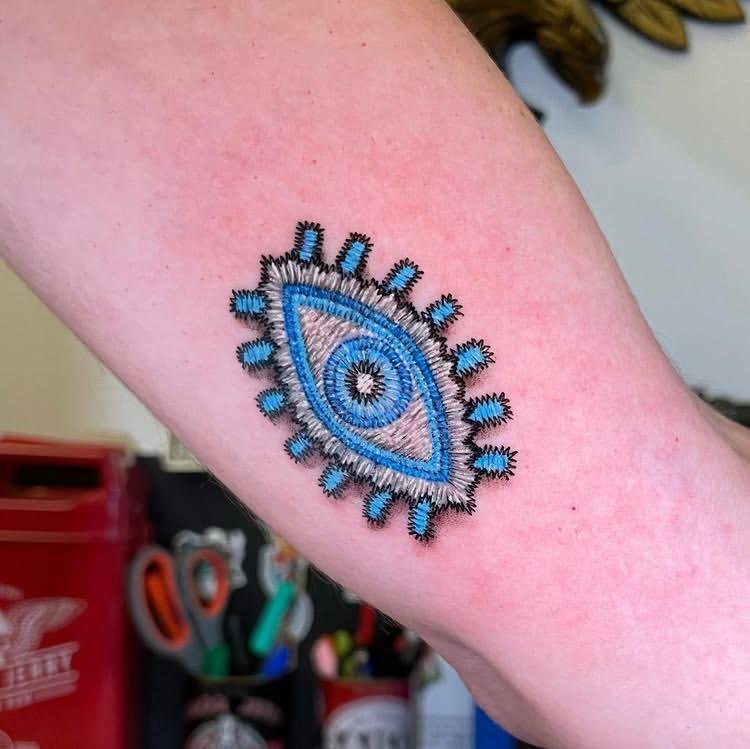
12. An Embroidered-Look Eye
Blue, black, and pale marks give this eye a stitched, textile-inspired finish. The textured edges make it look almost like a small embroidered patch, which offers a tactile alternative to smooth rings and precise outlines.
A thread-like effect needs enough room for the individual marks to stay visible. Ask the artist to show which parts will be outlined and which will use texture, then decide if the design should stay compact or grow slightly to preserve those details.
13. A Softer Hamsa Interpretation
Delicate curls and fine lines give this hamsa a lighter feel, while a small blue eye brings color to the center. Its airy outline keeps the hand shape visible without relying on heavy black fill.
Because hamsa designs have meanings in different communities, take time to understand the specific form you want before adding script or other symbols. The outline can be adjusted for a wrist, forearm, or shoulder, but its central eye should remain clear at the chosen size.

14. Three Eyes, One Graphic Statement
Three eye forms and halftone-like shading turn this upper-arm piece into an experimental blackwork composition. The sharper central eye gives the pattern an anchor, while the softer dotted imagery creates a printed, graphic texture.
This design uses repetition, so keep the spacing between each eye deliberate. Ask the artist to check the contrast at the final size and decide whether the dotted areas should fade gently or form a stronger block. That choice can change how bold the piece feels from across a room.

15. A Little Ornamental Crown
A bright blue eye sits below fine geometric details that form a crown-like outline. The combination of a color focal point and precise black lines gives this compact design a structured, decorative appearance.
Keep the crown shape readable by avoiding too many tiny points near the eye. A short vertical placement can make the design feel balanced, while a wider version may need more space. Decide how much ornament you want before the tattooer refines the stencil.

16. Colorful and Unexpected
A central eye sits within a colorful triangular frame, with small floral stems adding an unexpected botanical touch. Pink, green, orange, and blue shift the look away from a classic blue-and-black charm toward something playful and illustrative.
With several colors, select a palette that feels intentional rather than adding every shade at once. The triangle gives the composition a clear outline; the flowers can soften its corners. Ask your artist how the design will read in both close-up and at a normal viewing distance.

17. An Eye Beneath the Sun and Moon
A realistic blue eye anchors a design of fine sun, moon, and star details. The contrast between the shaded eye and lighter celestial lines makes the center feel strong without crowding it with a large background.
Let the main eye remain the clearest element, then choose just enough celestial detail to frame it. The symbols can suggest a personal connection to night, day, or balance, but their meaning is yours to define. A forearm layout can make the vertical arrangement easy to view.

18. Bold Blue at the Wrist
A vivid blue eye sits just above the wrist, with black rays and small ornamental accents giving it a finished edge. The strong color catches attention, while the simple centered shape keeps the idea easy to recognize.
Wrist tattoos stay in view during everyday activities and may be covered by a watch or sleeve. Test the exact location with your usual accessories and check that the rays do not collide with a bracelet. If you want a more discreet design, reduce the rays and keep the eye alone.

19. Flowers, Hearts, and a Tiny Evil Eye
A small blue eye sits beside pink flowers and two outlined hearts, creating a gentle, playful composition. The mix of shapes feels personal and decorative rather than ominous, and the limited size keeps the combination from taking over the skin.
Pick a main focal point—the eye, a flower, or the heart pair—then arrange the other pieces around it. Small compositions benefit from a little open space, so resist filling every gap. A simplified color palette can make the design feel more cohesive.

20. Dark Botanical Blackwork
A realistic eye sits within layered petal-like shapes, dotted accents, and a symmetrical black-and-gray frame. The combination of eye and foliage creates a larger illustrative piece rather than a tiny amulet-style symbol.
The darker areas need enough spacing to preserve the leaf and eye details. Ask to view the stencil across the inner forearm and decide how far the petals should extend. The source available for this recovered image is a Pinterest pin, so the credit below identifies it as a reference rather than claiming an original artist source.

21. An Eye Wrapped in Fine Ornament
Soft black-and-gray shading gives the eye depth, while fine curves fan outward like a decorative frame. The result feels refined and open rather than heavy, with the detailed eye acting as the central point.
Place the main eye first, then let the ornaments follow the length of the forearm. The curved lines should support the focal point instead of competing with it. If you prefer something more minimal, keep one or two flowing accents and leave the remaining skin open.

22. A Dramatic Burst of Blackwork
Long lines radiate from the eye to create a graphic burst, with dotted shading adding texture around the center. Its symmetry gives the tattoo a strong, high-contrast presence that suits someone who wants a more dramatic design.
The rays set the size and direction of the piece, so check their endpoints on the body before finalizing. A few shorter lines can make a compact version; a broader spread needs more space to keep its balance. Ask the tattooer how much black fill the final design will use.

23. Geometric Eye at the Nape
A blue eye is framed by overlapping geometric lines and tiny celestial marks at the upper back. The centered layout gives the design a clear axis and lets the bright iris stand out against its precise outline.
The nape can be shown with an updo or covered by longer hair and many collars. Check the placement with your hair pulled down and up, and ask the artist to center the stencil to your body rather than to the hairline alone. For another small placement, see our shoulder tattoo ideas.

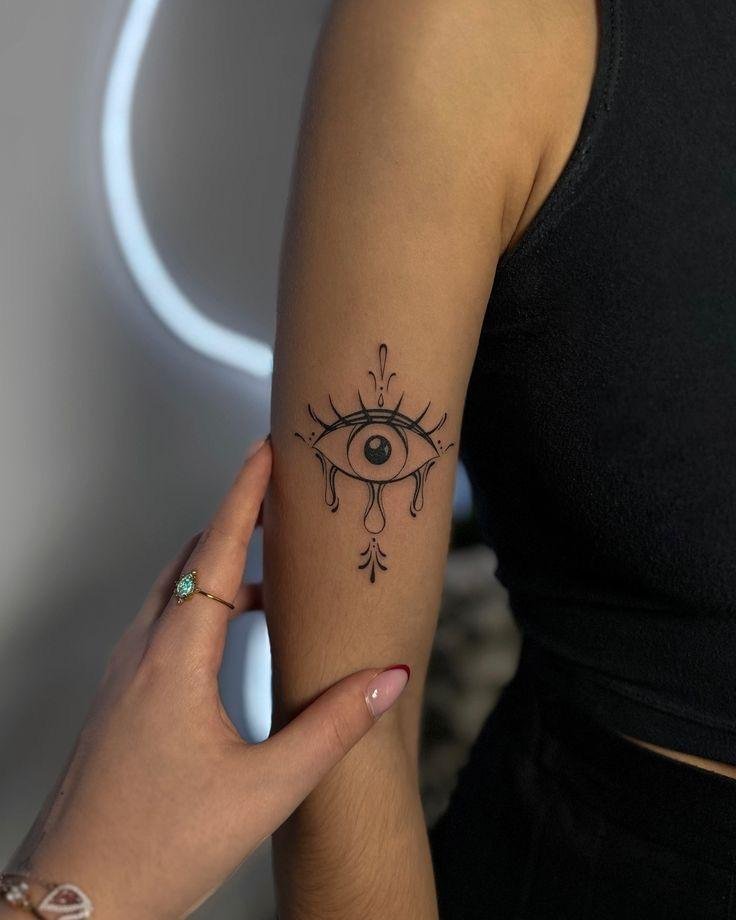
24. A Moody Dripping Eye
Clean black lines give the eye a surreal mood, with elongated drops and small decorative marks extending above and below it. The spare composition shows how a few strong shapes can create a dramatic effect without filling the whole area with shading.
Decide whether you want the drops to look like tears, ink, or abstract lines; the artist can adjust their shape to match your intent. The source available for this recovered image is a Pinterest reference. We link that reference in the caption below and keep the image itself unlinked.
25. A Botanical Trail of Blue Eyes
Small blue eye motifs travel along the wrist toward the hand among delicate leafy linework. The arrangement feels like a botanical bracelet, using several tiny symbols instead of one large centerpiece and giving the design a graceful path across the arm.
A design that reaches the hand is highly visible, so compare it with rings, watches, and any workplace guidelines you follow. Ask the artist to check how the line curves with your wrist and hand at rest. If you like tiny symbolic work, our behind-the-ear tattoo guide has another discreet placement to consider.

Choosing a Design and Placement
Begin with the version of the symbol you actually want: a simple ringed eye, a blue bead-inspired motif, a realistic eye, or an eye within another form. Decide whether color, linework, a frame, or a personal detail matters most. Then select a body area that gives those features the space they need.
Small placements such as behind the ear or near the wrist suit a simplified design with open spacing. A forearm or upper arm can hold a wider frame, multiple eyes, or detailed shading. The ankle and nape offer different levels of visibility depending on shoes, hair, and clothing. Try a stencil with your usual jewelry and clothes before settling on a final position.
Think about how a tattoo will sit beside existing ink, too. If the eye may become part of a sleeve, leave room for a future border or connecting detail. If it is meant to stand alone, give the outline a clear ending rather than filling the nearby skin by default.
Questions to Ask Your Tattoo Artist
- Can I see healed examples of this artist’s eye, geometric, ornamental, or color work?
- What size will keep the smallest rings, dots, or lashes clear?
- How will the design look from the front, side, and at rest?
- Can you help me check the symbol’s cultural context if it includes a hamsa, nazar, or another specific form?
- What should I expect during the appointment and while the tattoo heals?
Bring a small set of references and explain what you like about each one. A good consultation can turn those visual notes into an original composition rather than a direct copy of another person’s tattoo.
Tattoo Safety and Aftercare
Tattooing breaks the skin, so studio hygiene and aftercare matter. The U.S. Food and Drug Administration has received reports of infections linked to contaminated tattoo inks as well as allergic reactions to inks. Review the FDA’s tattoo safety guidance and ask the studio about its equipment and ink-handling practices.
Follow the aftercare instructions from your tattoo professional and seek medical advice if you are concerned about an unusual reaction. Once the skin has healed, the American Academy of Dermatology recommends broad-spectrum, water-resistant SPF 30 or higher when tattooed skin is exposed to the sun. See its guide to caring for tattooed skin for more information.
Frequently Asked Questions
Does an evil eye tattoo protect you?
Beliefs and meanings differ across cultures and individuals. Some people choose an eye symbol for its association with protection; others value a personal connection or its appearance. A tattoo should not be described as a guaranteed way to prevent harm.
Is a nazar the same as a hamsa?
No. A nazar is commonly represented by an eye-shaped bead, while a hamsa is a hand-shaped motif. Their histories and meanings vary by community, so research the particular design you are considering.
What is a good placement for a small evil eye tattoo?
Wrist, ankle, upper arm, and behind-the-ear placements can all work, depending on how visible you want the tattoo and how much detail it needs. Ask your artist to test the design at actual size and check it with your everyday jewelry or clothing.
Can I personalize an evil eye tattoo?
Yes. You might adjust the color, frame, or surrounding flowers and stars, or create a simpler outline. If the design includes a culturally specific symbol, make sure the additions do not change its context in a way you do not intend.
Final Thoughts
The most useful evil eye tattoo ideas help you decide which visual details and cultural references feel right to you. Save a few styles, research the specific symbol, and talk with an artist about placement and size before booking. If you are comparing other small designs, explore our shoulder tattoo ideas for another set of shapes and placements.